
R.A. Kosasih: The Master Who Brought Wayang Stories to Comics
Meet R.A. Kosasih, the comic artist who turned the Ramayana, Mahabharata, and wayang traditions into popular comics—and whose visual legacy continues to inspire Indonesian comics.
R.A. Kosasih: The Master Who Brought Wayang Stories to Comics
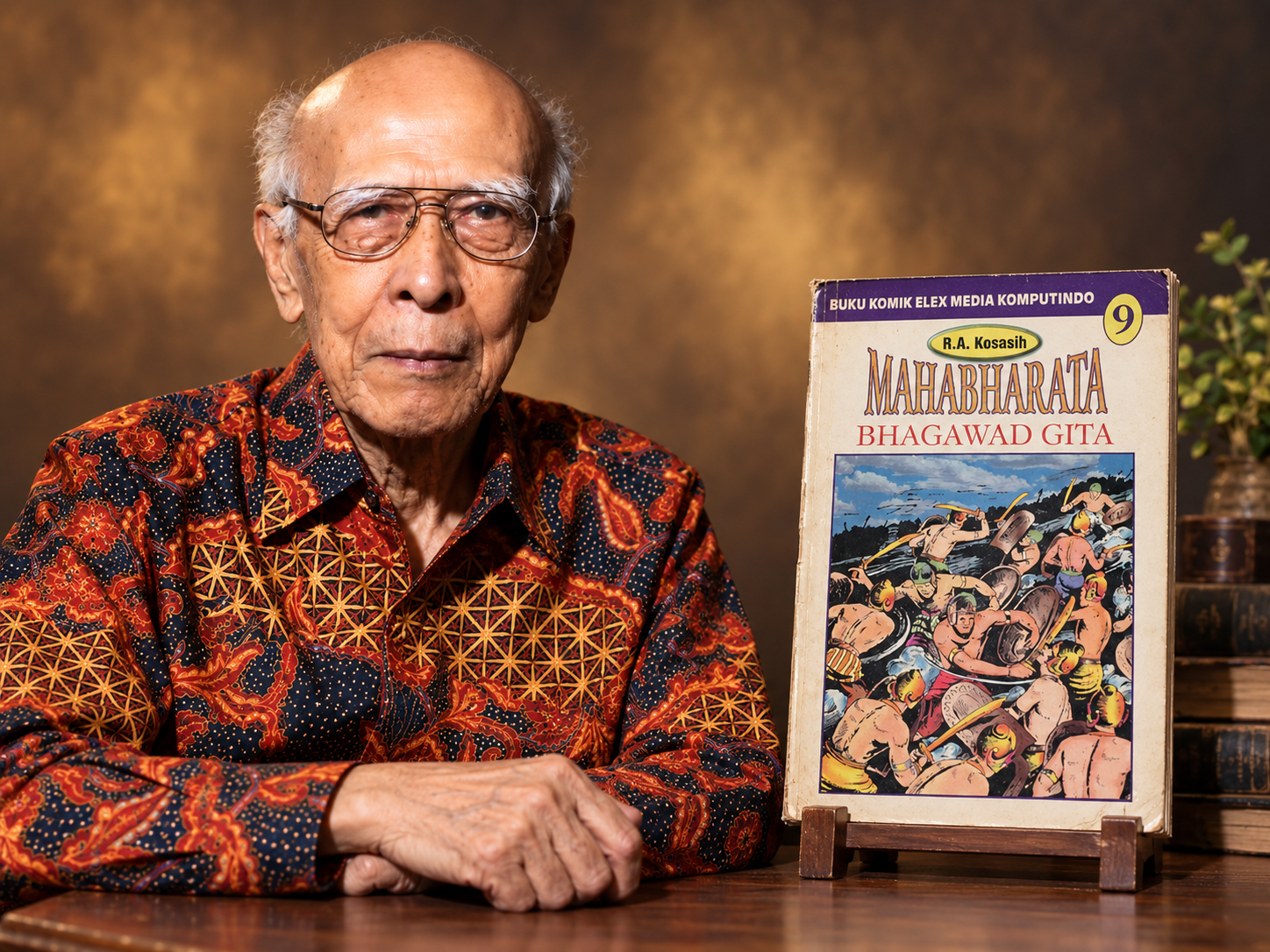
The name R.A. Kosasih is closely tied to the history of Indonesian comics. He is often called the Father of Indonesian Comics—an honorific reflecting the scale of his influence, not a claim that he single-handedly created the comic tradition in the archipelago. Among his many works, adaptations of wayang stories and epics such as the Ramayana and Mahabharata gave stories long rooted in oral tradition and performance a new form: page after page of comics.
Why are Kosasih’s works still discussed as reading habits and visual tastes change? The answer is more than nostalgia. His work shows how old stories can be retold through a popular medium without losing the characters, conflicts, and imagination that have kept them alive across generations.
From Raden Ahmad Kosasih to a major name in comics
Raden Ahmad Kosasih was born in Bogor on April 4, 1919, and died on July 24, 2012. He worked as both a writer and comic artist. His career developed at a time when Indonesian comics were finding their readers and their own publishing formats.
Calling Kosasih an important figure does not mean Indonesian comic history begins and ends with one person. Comics grew through the work of many writers, illustrators, publishers, and readers. Kosasih’s name stands out because of his productivity and the range of stories he drew, especially wayang tales and epics familiar to many people.
Why do wayang stories work well as comics?
Wayang offers a rich collection of characters, conflicts, family ties, journeys, and struggles over values. Before appearing as comics, these stories were already known through many forms of storytelling and performance. Kosasih brought some of that richness into sequences of images and dialogue.
This change of medium matters. A performance takes place before an audience at a particular time; a comic can be read alone, reread, kept, and shared. Panels divide scenes into visual moments. Character expressions, composition, and text work together to help readers follow the story.
An adaptation like this is not simply a performance copied onto paper. Every retelling chooses what to emphasize, sets its pace, and decides how readers will encounter the characters. This is where a comic artist’s skill becomes clear: the plot must work through images while preserving the heart of the story.
The Ramayana and Mahabharata in visual form
Kosasih is widely known for comics based on the Ramayana and Mahabharata. These epics have many characters and storylines, giving readers adventures, intrigue, loyalty, family conflict, and moral choices across a sweeping narrative.
Bringing stories of this length into comics takes careful adaptation and pacing. Readers need to know who is involved, understand the relationships between characters, and see why a decision changes the course of events. Images give faces and movement to names readers may previously have encountered only through stories or performances.
These works also became a way for readers to rediscover tradition. Readers unfamiliar with wayang stories can begin with a comic; those who already know them can enjoy a different visual interpretation. Comics do not replace every earlier form of storytelling, but they add another way to encounter it.
Sri Asih and the imagination of local heroes
Beyond epic tales, Kosasih is also known for Sri Asih, a woman with extraordinary powers who is often discussed in the history of early Indonesian superheroes. A character like Sri Asih matters because it shows that comic-book heroism does not have to draw its settings and characters from abroad.
Comic heroes can grow from local language, surroundings, and readers’ imaginations. Works like this raise a question that remains relevant for comics today: how can creators make a character feel connected to local experience while still appealing to a wide range of readers?
Publication histories and claims about who was “first” in a genre can vary depending on sources and definitions. It is therefore more precise to describe Sri Asih as an important work in discussions of Indonesian superheroes, rather than making one superlative claim the whole story.
An art style in service of the story
Kosasih’s work is widely associated with black-and-white art. Without color, lines, shapes, expressions, and composition play a major role in setting the mood and helping readers follow a scene. This visual choice also reminds us that comics do not depend on complex technology or effects to be powerful.
A page moves not through isolated images but through the relationship between one panel and the next. A character changing position, an expression shifting, or a scene being framed in a particular way can carry information and build emotion at once. Readers fill the gaps between panels by imagining what happened.
Reading older comics with attention to how they work—instead of only comparing their appearance with modern comics—helps us see the artistic decisions behind them. Every era has its own printing technology, reading habits, and visual expectations.
A legacy greater than nostalgia
Older works may be remembered because they bring readers back to childhood. But Kosasih’s legacy can be read more broadly: as proof that local stories offer strong material for popular media, and that comics can bridge tradition and new readers.
That legacy is not a blueprint to copy exactly. Today’s comic artists can take inspiration from the courage to adapt familiar stories, then choose their own perspective and visual language. Tradition stays alive not by being frozen in place, but by being read, discussed, and retold responsibly.
Remembering Kosasih also invites us to value the ecosystem that brings comics to readers: creators who write and draw, publishers who distribute the work, and readers who keep the stories in conversation. Great figures matter, but comic history is always built together.
How to start exploring R.A. Kosasih’s work
If you would like to explore his work, start with editions available through publishers, libraries, bookstores, or other legitimate collections. Check the edition information, since older works may be reprinted, edited, or arranged differently.
As you read, you might notice:
- How characters are introduced and distinguished through the art.
- How panels organize busy or action-filled scenes.
- Which parts of a traditional story are emphasized.
- How reading the comic differs from hearing or watching the same story.
This approach makes reading feel like an encounter with the history of the medium, rather than simply working through a list of titles.
Frequently asked questions
Why is R.A. Kosasih called the Father of Indonesian Comics?
The title honors his significant influence and contribution to the development of Indonesian comics. Comic history involves many people, so the honorific is best understood as recognition of Kosasih’s important role—not as a claim that there was only one pioneer.
Which works made R.A. Kosasih widely known?
Among other works, he is known for adaptations of the Ramayana and Mahabharata, traditional stories, and Sri Asih. Available titles and edition arrangements may differ between publishers and reprints.
Why are wayang adaptations in comic form important?
Comics offer a visual, accessible way to encounter traditional stories. Adaptations also show how a story can move between media and reach readers who may not have encountered it through performance.
Is R.A. Kosasih’s work still relevant to readers today?
Yes, especially as a way to understand the history of local comics and the possibilities for adapting Indonesian stories into popular media. Readers can also see how artistic techniques, formats, and publishing habits differ across eras.
A bridge between stories and generations
R.A. Kosasih is remembered not only for drawing great characters, but also for helping bring those stories to life on comic pages. Through adaptation, readers can meet stories whose roots reach far beyond the comic medium itself.
That is one of his most important legacies: showing that Indonesian comics can grow from the richness of their own stories. Every generation of creators and readers has a chance to continue that conversation in a new way.